
Concept Development and Design of Self-Transfer Devices for Wheelchair Users
##plugins.themes.bootstrap3.article.sidebar##
##plugins.themes.bootstrap3.article.main##
Abstract
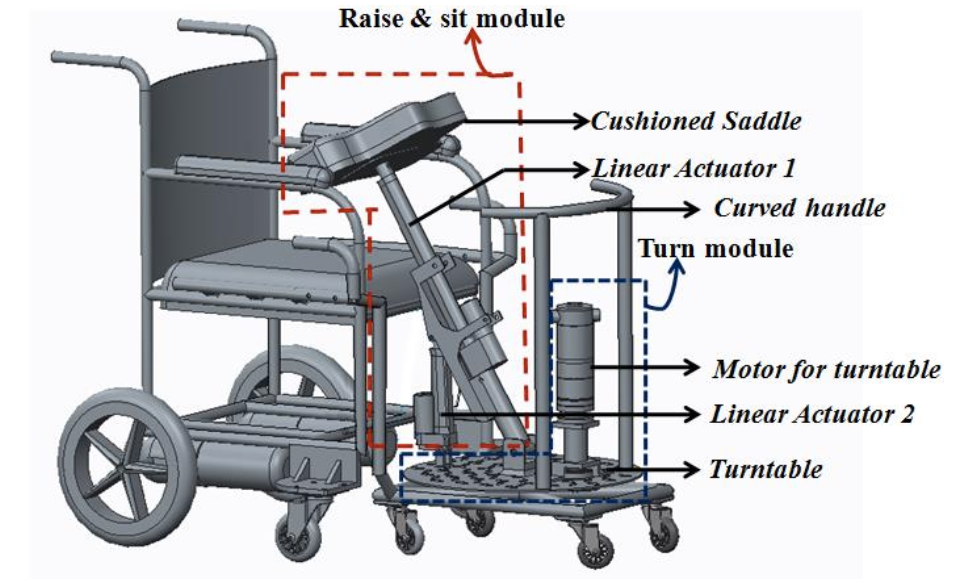
Movement disability not only affects mobility but also affects other daily activities of a person with disability which includes accessing toilet, moving to a chair, etc. A wide variety of mobility assistive devices are commercially available but, the devices that enable self-transfer of a wheelchair user from one surface to another, specifically addressing transfer to a toilet commode, is the need of the hour. In order to develop a manual and a powered self-transfer device, a methodical search of the entire solution space has been made by constructing a concept classification tree to decide on the choice of transfer posture, sequence of transfer motion, actuators, mechanisms and power source. Prior to this decision making, the procedure adopted for transferring a disabled person by a caregiver and the general techniques followed by the disabled people to transfer themselves in toilets are investigated. Later, after the conceptual design which is common to both manual and powered version is finalized, the design criteria and target specifications are put forward. Then, the self-transfer devices are developed that satisfy these design criteria and target specifications.
##plugins.themes.bootstrap3.article.details##

This work is licensed under a Creative Commons Attribution-NonCommercial-NoDerivatives 4.0 International License.